

Starvation Deep In Their Souls - Knut Hamsun's Hunger
A novel about starvation, of the body and of the soul...

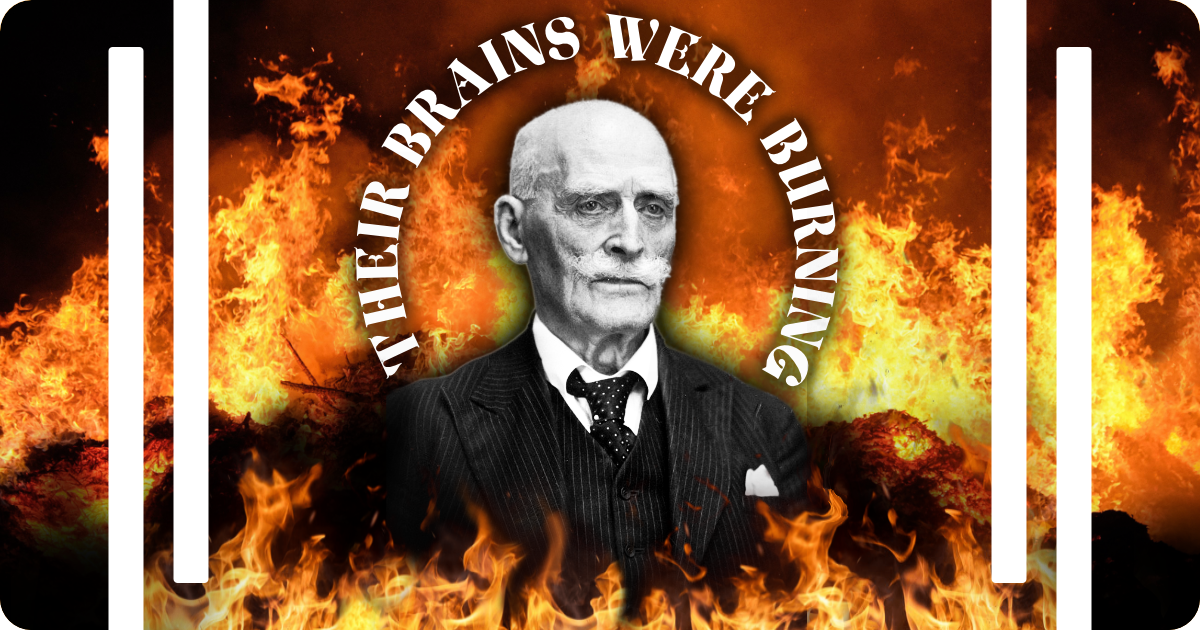
In Knut Hamsun’s disturbing but brilliant novel Hunger, his unnamed protagonist, a young writer living and working in Christiania1, attempted, near the end of his ordeal, to produce one single essay which he could sell in order to feed himself. His situation had already placed him at the threshold of death more than once and at this latter point in the story he had once again found himself penniless and starving. Madness had already begun to take hold, the intense, brutal emptiness in his stomach had spread to his entire person. His mind, rarefied by hunger, was prey to the aimless electricity of his vibrant brain. In moments of clarity he worked on his essay, an allegory about a burning bookstore. He was determined to get across that the books in the bookstore were brains and that they were on fire, they were being destroyed. In the breathless carousel of his mind, this thought returned on a cycle for several days.
“I wanted to give shape to the really deep thought that it was not the books that were burning, it was brains, human brains…”
I’ve read a bit of what scholars have to say about this novel and I’ve found them woefully off the mark when it came to their attempts to analyze the mindset and the evolution of its chief character. As always, they have routinely failed to place the events of the plot and the characters themselves in context with the wider world, both in the story world and in reality, which has in turn prevented them from gaining insight which could be applied to our present day. One of the most important functions of literature is to give us meat, substance, raw material with which we can then better understand the world. It was clear to me as I read Hunger that Hamsun was not just telling a story about a man starving to death on the streets of Oslo; he was showing the world that it too was dying of hunger. A great fire had taken hold of the whole world and no one seemed to notice but one lone man too hungry and too half-mad to even finish his essay about it.
Soon after this realization had occurred to him, the young writer was forced out of his lodgings for his failure to pay his bill. He abandoned his essay. The momentum of his madness and his decline was no longer stoppable. Delirious with hunger, he had, at last, reached that point at which he was willing to do almost anything for something to eat. The hunger had hollowed him out and he was faced with a choice: give in to the fire like everyone else and become an empty shell, or take drastic action.

Knut Hamsun lived and worked in Norway at the height of the glittering new Industrial Age. He also witnessed both world wars. Hunger was written before them, however, in 1890, in a time when Europe had just been fitted with the noose that wouldn’t finish tightening until the end of World War II. Industrialism had already destroyed communities that were hundreds of years old, it had laid waste to old customs, religion, history, traditions. Industrialism and the coming modern age would hollow out men and then leave them with nothing. This void inside every person would have to be filled. According to Hamsun’s observations (as conveyed to me by the translator), this void was filled with little more than base passions and rootless emotions. Man, according to Hamsun’s observations, had become animalistic, reduced to a material being driven by impulse and emotion rather than reason. This is visible in many of the characters in Hunger who are said to have been pulled largely from Hamsun’s own experiences:
We encounter school children who mock and terrorize a boy for his limp; a grown man who delights in spitting on the head of a child sitting under his window; a heavily pregnant woman who cheats on her husband with the tenants in their boarding house in front of the gaping eyes of her paralyzed father, while her husband amuses himself by watching through the keyhole. In the street at night, Hamsun’s nameless writer watches as shameless debauchery is stealthily carried out by what would otherwise be considered upstanding citizens of the city. Memorably, our hero is briefly involved with a young woman who, at first, seems noble-hearted and fair, but in the end reveals herself to be, in a sense, turned on by the prospect of a liaison with a dangerous, insane man. Our hero’s brief experience with her is marked by shame, humiliation, and the horrifying revelation both that he was detestable and that it was his very detestable, shameful nature that drew her to him. She did not want a man who was strong and virtuous; she wanted a man who was dangerous and insane. This seemed to arouse her. Yet when he revealed that he wasn’t insane, but merely poor and starving her opinion quickly changed2.
The reality that became gradually apparent to the reader was that Hamsun’s hero was not the only one starving in Christiania. And, as he knew himself, starving people will eat anything. But their starvation and his were fundamentally different. I believe this fueled his sudden — brief — inspiration regarding the allegory of the burning bookstore. His own mind often became feverish with hunger, it burned and things were lost in the fire. All around him he saw minds aflame with a different kind of hunger, a hunger of a deeper kind that was much harder to feed. Even he sometimes felt it take hold, he felt the passions and emotions overtake him and make him their slave and it was all he could do to regain control. Very often the only way for him to do this, to regain control, also put him in a position in which he was, once again, homeless and starving. That is to say, he repeatedly sacrificed his physical security for the integrity of his human soul.
For example, near the beginning of the book, a pauper begged him for a few coins. Our poor fellow had already gone some days without eating, but he took one look at the homeless man and went to a pawnshop to sell his waistcoat. We know from Hamsun’s stream-of-consciousness writing style that that was not done out of pride or a sense of obligation, but rather because of a simple awareness that the poor man needed money and had asked him for help3. At the core was the simple human act of giving a little money to a poor man. He didn’t think too much, he simply acted. This pattern repeats again and again throughout the book. Hamsun’s hero possessed a degree of what one could call integrity that is so extreme it might even be naïveté. But often the purest form of virtue is childish in its simplicity.
It’s interesting to note, too, that this integrity of his was constantly threatened by his hunger. In the throes of starvation he would sometimes engage in absurd dramatics, pretending to be someone he wasn’t, to know someone who didn’t exist, or to be in some business that he knew nothing about. While he was engaged in these confabulations he felt himself losing control, unsure why he was continuing but delighting in it all the same. This was usually followed by remorse, or at least by an awareness of the ignobility of the act. These moments were interesting to witness as they illustrated the increased lack of self-control that accompanied pervading starvation.
As he was somewhat self-deprecating by habit, he seemed to believe this was his “face” or his dignity that he was trying to preserve, but I think it would have been more accurately called his humanity, that is, the part of him that kept him from becoming an animal like the others. Perhaps this is a kind of dignity. After all, is it not our human, self-aware dignity that allows us to say that we are apart from the animals?
Hamsun’s hero — and Hamsun himself, presumably — was different from these burning brains all around him in self-awareness if nothing else. Even when he was again starving, homeless, and at the edge of death he still put aside one of the precious loaves of bread he’d manage to obtain for the boy who had been tormented by the spitting man. He still paid his debts to the heavily pregnant landlady and her cuckolded voyeur husband, though he refused to spend another minute under their roof. He still maintained his dignity and his sense of moral decency even when it could have cost him his life. He refused, in a sense, to give in entirely to the hunger. By the end of the book it’s difficult to say if it defeated him or not. But I’m of the opinion that it didn’t. I’m also of the opinion that it wasn’t just the lack of food that was driving him mad, but also the malignant spiritual starvation that was ravaging the entire city.
Many scholars have had frustratingly disparaging things to say about Hamsun’s hero. The nameless young man has been described as obstinate, stubborn, arrogant, and naïve. It has been said that he created his own problems — that is, he created his own hunger, that it was entirely in his head and easy to solve if he had just given in and become like everyone else — and that his dim view of his fellow man was hypocritical and even suggestive of a kind of perverse, even villainous, self-absorption.
I have personally observed that many scholars are inclined to dismiss (or condemn) any characters who would adhere to their own principles despite life-threatening circumstances. These scholars have a habit of calling such characters childish, accusing them of clinging to boyish misconceptions about the world or being unable to accept manhood or reality, unable to assimilate into the world of adults, or, alternatively, the world of progress. Such characters are very often defeated by the titanic forces against them (such as Holden Caulfield), and some aren’t. Hamsun’s hero is, I think, closer to the latter. But he lost quite a lot along the way. Still, he never completely lost his humanity to his hunger. I think it would be fair to observe that both the nameless hero and Hamsun himself (who was writing from his own experiences with prolonged starvation) learned an invaluable lesson during this period of defeat and deprivation.
This lesson was, in turn, delivered to the reader in the form of the allegory that this starving man had tried to write, an allegory that loosely fit his own situation, that of a man starving to death whose sanity, integrity, and even creative ability were damaged almost irretrievably by the strain of hunger. This allegory served as a delivery method for Hamsun’s theme, the idea that the people of his time were starving even more than he was, even more than his poor hero, that their brains were burning with an intense deprivation.
Some months ago, in the course of a conversation with a friend about the cascading avalanches of disasters that have been brought about by social media, I heard myself say the following:
“Social media is the worst thing that has ever happened in recorded history.”
Unfortunately, I have since found no reason to disagree with that statement, even several months after first thinking it. Naturally, it goes without saying that massacres, genocides, and the triumph of totalitarian regimes are all bad things. However, the fundamentally human aspect of them all is that they give birth to tremendous illumination. Some of the best writing in Russian history came out of the most abject horror man has ever experienced; the survivors of massacres and genocides are uniquely capable of teaching the rest of the world how to avoid the mistakes that led to those circumstances (whether or not the world listens is a different matter); the staggering pressure within tyrannical dictatorships allows the formation of diamonds. Suffering, like it or not, breeds growth. That doesn’t justify or excuse it, but the reality of human nature is that we learn and grow from struggle. So even if the struggle is beyond what any human can endure, it is nevertheless capable of making humanity better.
Social media, on the other hand, has not pushed humanity forward by even one half-inch. It has, rather, pushed humanity so far backwards that we now face a very real existential threat to mankind, to reasoned humanity, to intelligence, to common sense, to autonomy, to free will, to a future in which humanity, as such, continues to live, work, create, and endure. The simple, bare truth is that if social media continues to exist, humanity will not. It is more dangerous than AI will ever be, it is more dangerous than nuclear bombs, it is more dangerous than a zombie apocalypse. If you’d like: social media represents the arrival of the zombie apocalypse. And all of this, I realized, because it directly results in the incineration of the user’s brain.
As I finished reading Hamsun’s Hunger, I couldn’t help but find an analogy between the core, subtle theme of deeper, more spiritual hunger and this apocalyptic hunger that has scraped out the souls of so many human beings. Of course, it isn’t necessary to consider such an analogy in order to properly enjoy this book, but parallels of happenstance that open across centuries and eras should not be dismissed lightly.
We readers are always going to be inclined to take insight from our books which then allow us to understand our own world a little better. That is, in essence, the function of reading. Hamsun knew nothing of social media, he was not writing a prophetic allegory about Big Tech or the zombie apocalypse or TikTok. He was writing a book about a man suffering from physical hunger who came up against — and was demoralized and nearly defeated by — spiritual hunger. It is impossible not to borrow this insight for the existential threat currently burning through the entire population.
Some time ago I published an article about the Italian novel The Twenty Days of Turin in which the author very much did accidentally foretell the coming of social media and the horrifying ends it would produce in the minds it ensnared. One sees in those pages precisely the same thing: starvation. This was represented in Turin by an insatiable thirst. But the essence is identical: starvation. Or, to borrow the original Norwegian of Hamsun’s novel, sult, which, according to my Norwegian-English dictionary, can be translated as either “hunger” or “starvation”. Whether it’s the bleak absolutism of the Industrial Revolution or the all-consuming brain fever of social media, the end reality is that human beings are starving and that this starvation has set people’s brains on fire.
Industrialism and all that came along with it, which Hamsun himself witnessed, was indeed setting aflame the humanity of a large percentage of the human population, leaving them little better than animals, but even within that fire illumination was possible. Some minds responded to the fire of spiritual incineration by awakening to the deeper privations of our progressive modern age. My hope is that the fires of social media can do the same. My fear is that too much has already been lost in the flames.
Observations gleaned from literature are valuable, of course, but not half as valuable as solutions. The solution to the hollowness of modern society was, to the hero of Hamsun’s novel, both incredibly simple and almost impossible: it was to never let go of one’s core, elevated human soul. The narrative structure of the novel was such that he would endure a series of moral crises in which he was sorely tried but to which he did not succumb, until, when he had persevered as long as his strength could hold out, fate extended a hand to save him. The chapter that began with his selling his waistcoat to give money to a poor beggar proceeded through a series of increasing privations and baffling slips of humanity while he diligently labored to construct an article of sound quality which, at the moment of ultimate despair, he sold for a tidy sum. The chapter in which he found himself under the roof and within the poisonous miasma of the adulterous landlady and her voyeur husband, proceeded until he decided it would be better to be homeless on the street than endure one more night in the presence of that kind of base depravity. At the moment he walked out of her door he received a letter which contained a large amount of money.
The lesson is plain: the world can be ugly, but difficult, costly virtue always overcomes the animalistic base habits and impulses into which humans often fall when they are starving. Maybe the reward isn’t glittering triumph or a clear happy ending, but one does get to keep one’s humanity, and in a world where such a treasure is rapidly disappearing in the fire, maybe that’s enough.
Modern day Oslo, Norway
I have heard it said that this woman might have been a prostitute who was merely upset that he couldn’t pay. But my reading of the scene didn’t support that at all. I don’t think she was a prostitute (or if she was, I don’t think she was pursuing him as a client), and it was clear in her reactions to his feigned madness and then to his admission of merely being starving that the madness aroused her and the starvation bored her.
Indeed, there was an element of unconscious self-deception: if he had enough money to give to the poor then surely that meant that he wasn’t poor himself. This self-deception is intriguing both because it is a common feature among the spiritually starving, and also because it was his gradual acceptance, over the course of the novel, that he was poor and starving — physically and spiritually — that finally allowed him the strength to escape.
Powerful words Hilary. Your review of the book challenges me. Which translation did you read?
I am not as pessimistic about the social media threat to humanity. The pendulum swings to the extreme just before it slows, pauses and heads back on the arc it had traveled.
sounds like a profoundly gnostic novel