

To help with the large cast of characters,
I have put together a spoiler-free Dramatis Personae
Sixth day of the River Voyage

All monks of Ávoth maintain boats. The rivers are as much a home to them as their tidy blue temples.
Before they departed, Min La learned that the village in which they had found themselves — the one where the monks had labored to protect and also to heal them — was in a little village called Tŭbar1, meaning “gray cover” as the sky there was so often enclosed in the gray cotton shroud of storm clouds or else in a thick fog from the river.
The monks’ boat was named Nal Dor, “blue hand”. It was a fitting name. The hull was painted blue entirely, from bow to stern, with the name and a fine image of Ávoth’s head painted crisply upon the transom.
Fresh white rigging matched the crisp white mainsail which had been painted, on the luff side, with the tall figure of the mournful Ădol, his bare feet nearly touching the shining blue boom.
The many cabins below deck had been arranged and outfitted in much the same way as the modest rooms at the temple. There was also a simple galley for preparing meals. Min La and So Ga had been given a cabin nearest the galley, deep in the bowels of the Nal Dor, where the two young brothers could feel safe. Ŏnin had seen to this and had made a point of showing Min La just how difficult it would be for anyone to reach them. This cabin had been the least desirable to the monks as it had no porthole. But, as Ŏnin had suspected, this made it particularly pleasing to Min La.
They spent the first two days of the River Voyage recovering. So Nan — or So Ga, as his brother called him — slept frequently but seemed to recover his appetite quickly. His color and his energy soon followed and though he was loathe to be parted from his brother, he did submit to another dose of medicine on the first evening. With the permission of his brother, he soon took up a position in the galley helping old Brother Noba prepare meals for them all.
Min La took longer to recover, as Ŏnin suspected he would. Driven to the brink of exhaustion, he had slept even longer than his brother. Waking, he had not seemed rested, but instead moved fitfully below deck, standing occasionally at the foot of the ladder gazing up at the pale daylight as if it was threatening him.
His spirits seemed to improve when So Ga showed signs of recovery. For a time, however, Min La avoided his brother, keeping apart from him though close enough to watch him. Ŏnin knew that he still blamed himself for what had happened at the temple. Ŏnin believed that there was very little in this world for which Min La did not blame himself.
On the fourth day So Ga took food to Min La — who had skipped several meals — where he sat on a stool near the foot of the ladder that led up to the Nal Dor’s deck. Pulling him by the arm, he took him up into the brilliant blue twilight and they remained there, talking quietly for some time. Thereafter Min La’s behavior seemed more at ease. He began to eat again, perched near his brother, and even allowed himself to be put to work by the monks. Ŏnin was glad for it. Though it seemed the young man was always near exhaustion no matter how much he slept. Perhaps that would only change once they reached their destination.
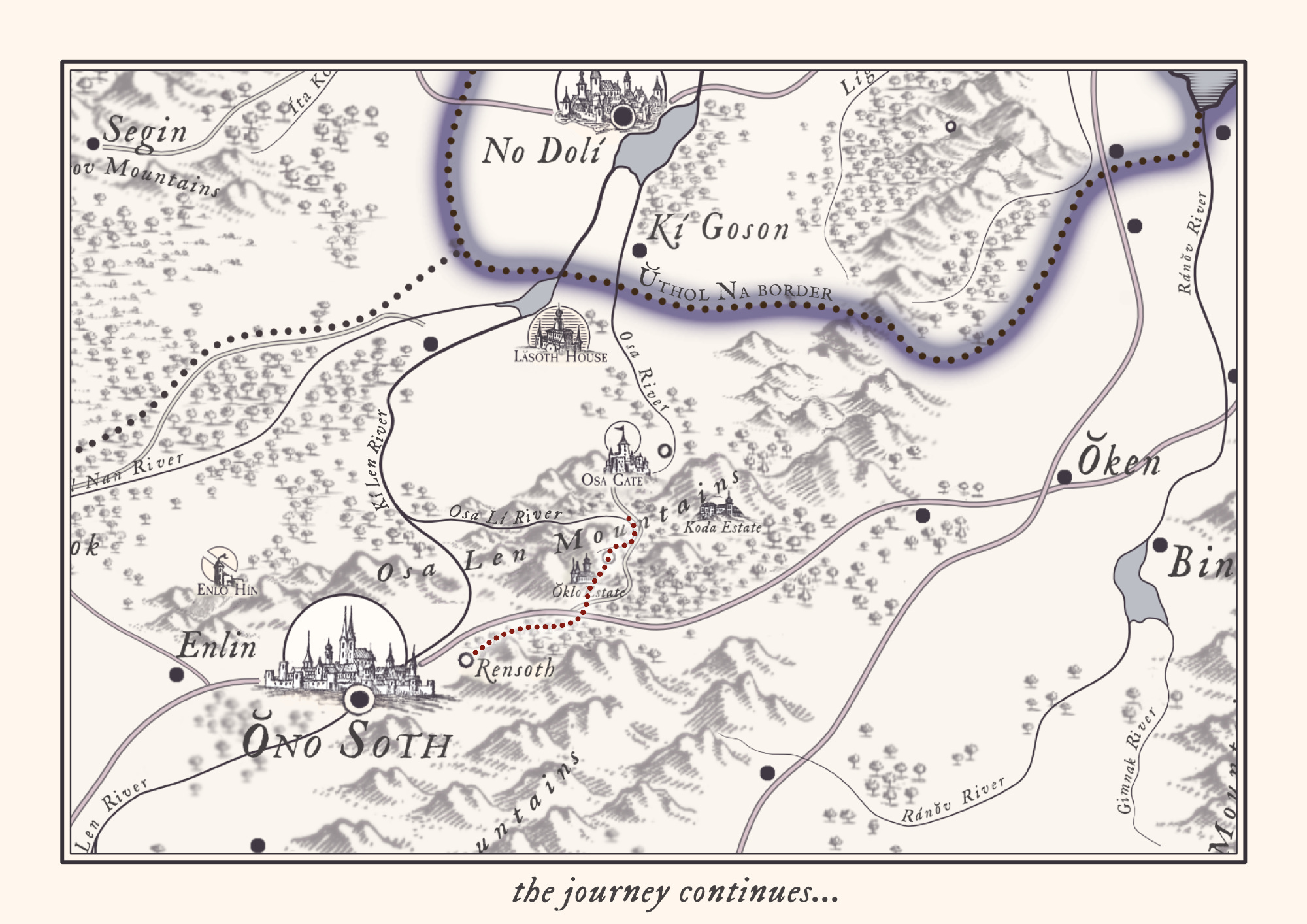
Every evening the Nal Dor would move north down the Osa Lí River, and every morning they would dock and erect the temple tent where pilgrims could come to offer their dead. This was a large, open structure made by stretching blue waxed linen over a simple birch wood frame. This frame was easily disassembled into smaller pieces which could then be stored below deck and easily assembled within an hour in the morning. Min La proved particularly adept at this. As his knee improved, the monks found themselves relying on him to erect the blue temple tent every morning.
Inside the tent, just under the blue canopy, they hung the pilgrim tapestry of Ávoth. Cushions were placed throughout where the monks could sit. Silver bowls shone in the winter sun as the pilgrims placed their dead inside. Usually these were simple folded papers, but sometimes they were sealed with wax, or even tied with ribbon. Just outside the tent hung dozens of blue lanterns — these also decorated the deck of the Nal Dor. Boxes of candles were set out for the pilgrims to use. Of all the supplies carried by the monks on the River Voyage, candles took up most of their storage space. These were short, fat candles which required no holder. Lighted by pilgrims, they could be placed on the ground. In time the path to the monks’ blue tent would be lined with fire. The monks would always use these candles to maintain the lanterns on the Nal Dor as a way of keeping Ávoth’s fires lit. The rest were left on the ground when the tent was taken down and the boat moved on. Many would come to use them to light their own household candles and lanterns for their Inner Rooms. Despite the enormous quantity they carried, the candle boxes were still carefully rationed to ensure that the monks didn’t run out before the end of the River Voyage.
On the morning of the sixth day, Min La had sat quietly in his borrowed blue monk’s robes after erecting the tent. So Ga was still sleeping below deck and he was waiting for him to wake to eat with him. He sat with his hood drawn low and his back to the tapestry of Ávoth. He didn’t even seem to notice when the pilgrims began to arrive.
Presently, a rising whisper moved through the quiet crowd on the bank of the river. The people started and turned, each straining to see behind them without behaving in a way that was inappropriate for the setting. Ŏnin, from his cushion near the front of the tent, watched with interest as the crowd parted and a tall man appeared wearing a blue golt and a coat of pale green, the color of the Koda House. The man’s long face was severe but calm, his long hair moved in the chill winter breeze. He rested his hand upon the pommel of his sword, the other behind his back.
Ŏnin knew him at once. This was Tá Nom, the heir to the Koda Housemaster, the shrewd and wise Gin Ja Koda. Tá Nom was her eldest son, the one most like his noble father. Several men were with him, but no women. It seemed Gin Ja had not come herself, but had sent her son to deliver the Koda dead.
Tá Nom and his House had earned a reputation in this part of the Osa Len Mountains. There was, of course, the prestige of being given charge of the royal silver mines, but they were also known to guard closely their roads and villages. Koda lands were among the safest in Sona Gen. Their new villages were prosperous and their dealings with other Houses were fair. As a result, Tá Nom was admired and respected. Ŏnin was not surprised to see him. Many of the noble Houses chose to deliver their dead with pomp and ostentation, as a display of their piety. Others chose to do so quietly in an effort to avoid the same. Tá Nom Koda, as usual, did neither. He made a point of approaching the River Voyage as any man would. But he also made a point of being seen. This would be the influence of Gin Ja, Ŏnin knew. Tá Nom’s behavior reflected on their House. And if their House maintained a noble, respected reputation they could more easily keep their power. If they remained powerful, they could continue to govern their lands well enough to benefit all who lived upon them. There was no room for false modesty in the court of Koda.
Ŏnin gestured as Tá Nom approached, inviting him to kneel before him so that he could receive the Koda heir’s dead. Tá Nom bowed — together will all his men — and then knelt.
Though Ŏnin arranged his blue robes in order to receive Tá Nom Koda’s dead according to the rites, the man instead spent a moment looking about the tent and even at the Nal Dor behind them. Ŏnin waited.
“It gladdens my heart to see that there are still young men in this world who wish to devote themselves to the service of the Ădol.” Tá Nom bowed his head as he spoke, his gaze alighting briefly on Min La where he sat behind the row of monks, his blue hood casting a deep indigo shadow across his face.
“As long as there are Ădol,” the old monk replied, also bowing, “there will be men willing to serve them.”
Tá Nom bowed again and Ŏnin again moved to receive his supplication.
“It is a striking resemblance,” Tá Nom said. Ŏnin started slightly and opened his eyes. The young Koda heir was still staring at Min La, a small smile on his long, inscrutable face.
“Resemblance, my lord?”
“This young monk.” He nodded at Min La. “The way he is sitting and the way his cloak falls, his youth and his long hair. Does he not remind you a great deal of the very Ădol whom you serve?”
Ŏnin turned then, surprised to have his anxious tension allayed by such an observation. He looked behind Min La — who was doing an admirable job maintaining the air of a contemplative young monk in the face of so many onlookers — at the woven tapestry from the Om Lun era that had been gifted to their little temple two centuries ago. This was a pilgrimage tapestry, intended for this very purpose, to be hung for veneration at every stop along the annual River Voyage.
Like most pilgrimage tapestries, the design was ornate but simple. Meant to provide sacred imagery for the people visiting the pilgrimage, the primary depiction was always, of course, Ávoth. Most depictions of the young Ădol showed him standing ankle-deep in one of his beloved rivers, arms open to welcome the recently deceased. Always with a blue hood and a long blue cloak. Always with long hair and always with his eyes closed. And usually his hair was white, like his father’s.
In the pilgrimage tapestry that the monks had displayed, however, Ávoth was not standing, but sitting cross-legged on the far bank of a narrow river. His long hair, instead of being white, was the same gray as the river water. His pale hands were open on his knees, palms up. In the background the moon and sun shared the sky. A section of Ávoth’s fluid blue robes had stretched across the river creating a kind of bridge.
Ŏnin had always favored this depiction for pilgrimages, as it suggested that the young Ădol was receiving the supplicants who would come in droves to offer the names of their deceased loved ones to the passing monks.
Looking at it now, with Min La sitting idly in front of it in the dim yellow light of late morning, he too was struck by the similarity.
The blue cloaks they had given to Min La and So Ga had been ample enough, the old monk had hoped, to hide the young men’s identities. But the way Min La sat wrapped and almost cocooned in it, the deep blue fabric had stretched around his shoulders and draped across his lap to almost exactly resemble to robes of the Ădol on the tapestry behind him. Min La had drawn his hood low to conceal his face, but his hair fell long across his chest and blew slightly in the autumn breeze like lengths of tangled black ribbon. His eyes were closed in what could have been contemplative prayer. But the old monk had come to understand the boy well enough to know that he was more than likely just trying not to fall asleep.
At that moment, however, Ŏnin could distinguish no difference between the young man wrapped tightly in borrowed blue robes and the melancholy Ădol on the tapestry behind him. The image, he perceived, had been doubled. It filled him with a certain mournful dread to see such mirroring and he wondered if perhaps he had committed some grave error by putting Min La in the robes of Ávoth. Would the mournful Ădol be drawn to his own image accidentally duplicated in the living world? Would the gloom of Ávoth haunt the shadow of Min La from this moment on? It seldom brought good fortune to be among the beloved of Ávoth.
“Brother?”
Ŏnin started. He had entirely forgotten about Tá Nom Koda who still knelt before him, still wearing that unreadable smile.
“Yes, my son?”
“Would you permit me to present my dead to this young monk? Perhaps it is foolish, but I entreat you to humor me, if it is within your power.” He held up his blue envelope, which had been wrapped in white string and sealed with the wax seal of the Koda House. It was the more formal means of delivering supplications, but was quite common among the wealthier Houses. The Kodas had also left an offering of food. No donations were accepted along the River Journey save what was needed for the journey itself. Monks of Ávoth did not eat fish and so offerings of meat and grain were most common. The Kodas being wealthy had also given fruit.
Ŏnin bowed slowly and made a great production of standing, his arms tucked into the heavy blue sleeves of his worn robes. The Koda heir waited on his knees while the monk approached Min La and knelt next to him.
Min La stirred when he heard his voice whispering in his ear. Then he nodded.
Ŏnin positioned himself by the young man’s side and then motioned for Tá Nom to approach. Min La had recognized him immediately but kept his eyes down.
“This is our little brother’s first River Voyage,” Ŏnin said to Tá Nom. “I will help him receive your dead.”
Tá Nom bowed to both of them. “Thank you.”
With Ŏnin’s practiced help, Min La extended his arms until the vast lengths of blue cloth had unfolded from his lap, then he held his arms out to Tá Nom, who did not move. Slowly, Min La pulled his hands back inside his sleeves, leaving a pool of blue fabric stretched all the way across the narrow divide between him and Tá Nom, with the edge of it just touching Tá Nom’s knees.
The Koda heir placed his blue envelope on top of this pool of blue cloth. Min La reached forth with one hand wrapped entirely in his sleeve and folded the envelope into the fabric, like a wave of water swallowing the sealed envelope. The length of fabric that had bridged the divide between them disappeared, and with it, Tá Nom’s dead. Following Ŏnin’s whispered instruction, Min La bowed deeply, his chest almost touching his knees. Tá Nom mirrored his bow and they both remained in that position for some time.
Ŏnin could not make out what the Koda heir whispered to Min La then, but the message was lengthy. When he was done, he stood up. With the same unmoved smile on his face, he bowed to both of them and, together with his men, he took his leave.
Ŏnin studied Min La’s face as he straightened from his bow. The boy did not seem troubled, not any more than before. He didn’t think the boy’s face could get any paler than it already was, and though he seemed calm, Ŏnin had only seen his calm broken when his brother had been in danger. Whatever message the Koda heir had carried, then, it could not have been a dangerous one. The monk wondered if it had been the opposite, if the dignified and unreadable heir of the Koda House had perhaps come here specifically to provide some aid to the pair of them. Had he done this out of the kindness of his heart, Ŏnin wondered, or because it would benefit his House in some way?
But he shook his head. Such speculations were not for an old man. And certainly not for an old monk.
Another monk came from the row in front of them to take the sealed envelope. Min La used his fabric-wrapped hands to place it in the silver dish that the monk held out to him. Relieved of their burden, his hands stretched out from the sleeves and Ŏnin saw that they trembled slightly.
“My son?” the old monk said.
Min La shook his head. “Where is he?” he whispered, referring, of course, to his frail brother.
“Sleeping in the cabin.”
“We will leave after he wakes.”
“Another day on the river will get you closer to your destination.”
“Another day in the pilgrimage might attract too much attention.” He turned to look at Ŏnin. His pale young face framed as it was by the blue cloth was so like Ávoth’s that it made the old monk a little afraid. “We have already invited too much danger into your lives.”
Ŏnin knew it was useless to argue. And, in truth, the young man was not wrong. Clearly the Koda heir had recognized him. Perhaps the blue robes and the company of the monks were not enough to hide them after all.
“Tomorrow night,” the old monk agreed. “After we burn the dead.”
Or, if you’d prefer to make a small, one-time donation, you can
TIY-yuh-bahr
I am really curious about what Tá Nom said to Min La, since it made him decide on the spot that he and So Ga needed to leave the monks.
I often wonder how these 2 will tackle such complicated world they live in.. so much to think about
Anyways I'm not sure if it's a typo but it seemed off(?) " The monks would always used these candles to maintain the lanterns"