

Fanfiction Ruins Everything
A peek into the world of fan fiction and how its pomps and works have bled into mainstream storytelling...

This article and list is meant to act as a companion piece to my Youtube video.
An Important Note
I suspect many who watch my video and read through this list of resources might arrive at the end with the impression that I want to “ban” or “censor” AO3 and other fan fiction sites.
THIS IS NOT TRUE. I have not said this and I will not say this because I don’t hold that opinion in any way.
I believe that adult human beings are obligated to maintain the health of their own minds themselves. It is every person’s responsibility to guard his or her own mental and moral health. I believe that it is right and prudent to warn adult human beings that some things out there might cause them harm, physically, mentally, emotionally, or morally. My aim with my video and this list is to do just that: warn adults. What those adults do with that warning is up to them.
That said, anything having to do with sexualizing a child, or a character meant to look like a child despite being canonically an adult, is repugnant, evil, and should absolutely be stricken from the internet. Producing such works is actually illegal,1 but is rarely prosecuted. People have been convicted for possessing sexual drawings of children in an anime style and for other “artwork” of this nature, particularly if the work is obscene. However convictions for text-only work are harder to obtain. It is, nevertheless, not protected by the First Amendment — as is often claimed, particularly in AO3’s ToS — especially if it is obscene.
When I was in my twenties, I was absolutely one of those sensitive, aesthetically-minded young women who was drawn to the indulgent escapism of literature and storytelling across mediums. I absorbed fiction and books and loved finding places online where, ostensibly, similar-minded people tended to gather. My time in these spaces was on the very edge of a cultural transition that probably wasn’t noticed except by those accidentally in unique positions, such as myself. As I tended to keep to myself, I was less immersed in these communities and saw for myself as they shifted under and around me. Literary communities such as those on tumblr dot com gradually, then suddenly, slipped into smut and “shipping” and then became entirely pornographic. The language with which these communities interacted with any and all media was that of fan fiction. A new story emerged in the world and it was immediately run through the fan fiction engine and only in that form was it ingested. In time I saw this spread elsewhere.
A lot of this was clearly in an effort by the audiences to see themselves mirrored in the work. Characters had to be made gay or queer or trans in order for the gay, queer, or trans community to identify with them. Characters were also often race or gender swapped for the same reason. Resistance to this was often met with the predictable cries of “[blank]-phobia!” Because if the character — in its altered, fan fiction form — now mirrored the creator, and thus was, to some degree, the creator, having a problem with that reimagined character was the exact same as having a problem with the creator, or anyone else who identified with the character. Every single aspect of which, by the way, is fundamentally contrary to literary integrity.
Characters also had to be made to be in love with other specific characters for reasons having to do with representation or sexual and emotional satisfaction.
Once it was clear that no one had any interest in engaging with canon stories for what they were, I left these spaces and these communities, if I could ever really be said to have been “in” them. As I saw it, I was in a lovely literary neck of the woods and then I looked up one day and realized that my neighborhood had become gentrified by fan fiction, so I left. Nevertheless, my time there and my constant awareness of those parts of that world that overlapped with my own (the literary world, whatever that means in these days), has allowed me to observe certain repeated patterns. And none are more obvious and worrying than the growing power and prevalence of fan fiction in the literary world.
I’ll leave it to my video to address these issues and my observations in that regard. But for those of you who want to educate yourself further or see for yourself the various things I touch on in the video, here’s a (somewhat disturbing) list of resources. Gird your loins and go with God.
AO3, or Archive of Our Own
The primary internet home of most fanfiction was created almost entirely in response to numerous clumsy efforts by the hosts of sites like LiveJournal and FanFiction.net to cleanse their spaces of material that crossed into taboo (e.g. incest) or illegal (e.g. child porn) territory. This was done mainly because of external pressure from groups that were trying to curtail the growing prevalence of exploitative material on the internet. I seriously doubt those original host sites cared much about the content users posted on their sites, but the pressure was significant. Because of this pressure — and their ideological indifference — these purges were, as I said, clumsy. Swathes of content were unceremoniously deleted, including sites dedicated to actual survivors of abuse. Then they would quietly allow the forbidden again for a while, then the pressure would come again and they would delete another huge batch. This, combined with some difficult to navigate efforts on the part of large media companies to retake control of fan fiction, led the community to create their own fan-run space. That became Archive of Our Own, or AO3. This site is run by a non-profit with a board of directors and subsists on donations from users. It has been in existence for over fifteen years.
Because the main, original impetus of its creation was “censorship”, as they called it, this is the guiding principle of AO3’s content policy, what they call “maximum inclusiveness.” Literally nothing, nothing is disallowed. If you go to, for instance, the various fan fiction subreddits and read conversations about taboo topics or disturbing tags, you’ll find that the only acceptable opinion in the community is that absolutely nothing can be off-limits. To even suggest that a conversation on the topic ought to be had will cause a person to be shunned and condemned.
Here is a link to the official website of the Organization for Transformative Works, or OTW, the parent non-profit that owns Archive of Our Own, or AO3.
Here is a link to AO3, though I do not recommend browsing casually.
Here is a link to OTW’s journal Transformative Works and Cultures, which features academic articles, of a sort, relevant to topics important to the fanfiction community. This is almost exclusively issues of identity and representation. Some article titles:
“Disordered eating, disordered reading: Wintergirls and the fannish practices of pro-ana”
“‘I wish my life was like this’: Queer identity work in BL fandom”
“Fan perspectives of queer representation in DC’s Legends of Tomorrow on Tumblr and AO3”
“Self-identification in Malaysian cosplay”
You get the idea.
I. The Self-Indulgence of Fan fiction
I.a. The Terminal Cancer of Representation and Identity
The idea that only people of certain identities can write stories featuring those types of characters or themes is sometimes called “Own Voice” or even “identity gatekeeping”.
There are several conversations on the fan fiction and AO3 subreddits that illuminate the community attitude towards this issue. And while many seem to think that broad-spectrum identity gatekeeping is bad, they do not ever recognize the fundamental issue. That is, at their core, the fan fiction community still believes that representation and identification is of paramount importance and so even when they caution against too much identity gatekeeping, they still advocate for the spirit of the issue. Take this reply, from this long subreddit conversation on the topic.
“There’s a difference between saying someone can’t write something and someone needing sensitivity readers before they publish a work.
For instance, if I was going to write a trans character, I might want to contact someone who is actually trans and get their perspective on certain things before I publish the work. And if this was a “real” publication, like for money and big wig publishers, and not fan fiction, I hope that that would be almost the norm (although it’s sadly not). Fan fiction is a bit different because it’s not something you get paid for or can pay someone for their time to read over your work and make sure it’s an accurate description and portrayal of their life.
There’s a big push towards diversity in media which is great! I love seeing all of these different ideas and identities come to life in front of me, but people have a tendency to get mad when they don’t go the way they plan for them to.
Which leads to this strange world where you potentially have to out yourself or your mental illnesses or race or even disabilities in order to be qualified to write these stories. Am I, a bisexual women of mixed heritage, allowed to write stories about people who don’t look like me? Sure, that’s fine. But the second I want to write about people who look and sound and act like me I’m met with resistance, people wanting proof that I’m Mexican/Native American or how many women have I dated?
Gate keeping can only hurt us in the end. If I hadn’t been allowed to write the fanfics that I did, I never would’ve been able to accept my own sexuality. If we restrict our own stories even more, then we’re only reducing the amount of them out there. We can weed out the bad ones (the ones with terrible representation or stereotypes), but we can’t put more stories out there if everyone’s afraid to write them.
In this fan fiction subreddit conversation a writer spoke about getting hate mail and death threats for making a canonically gay character straight. The post was mass reported and then locked. But it did receive a few illuminating replies:
“The thing is, straight characters are everywhere. They’re the default. If a character in any given media is not, specifically shown to not be straight, it’s assumed they are. LGBT+ people are constantly forced to accept this whenever they consume media, because actual, canon queer characters are so incredibly rare.
So if a writer (and straight writers do this too; I’m one of them), take a canonically straight (and again, if they’re not stated as not straight they’re considered straight) and put them into a same-sex relationship, there are literally handfuls of other, canonically straight characters still in the work of fiction. It’s not a big deal. However, if someone turns the most likely single queer character of the work straight, it’s a huge deal, because there isn’t anyone else like them.
It’s the same reason why killing of a character of color hurts so much worse than killing off a white character. Chances are the COC was the only one, and there’s always going to be another white character. There’s always going to be another straight character, too.
When that one, single character who is actually like you is taken away, even if it’s in fanfiction, it hurts.”
and
“In a completely objective, rational, unemotional world - you are allowed to change any character into any sexuality or gender that you want to.
In reality - people are very protective of the few characters that represent the minority they identify with.
You can write whatever you wish. People can hate whatever they want. I’d turn off the comments or moderate them if I were you. And I really hope you tagged for it.”
and
“I don’t think you deserved hate mail or death threats for writing a gay character as straight, but it is a gauche thing to do. Flipping a gay character to straight is much different than flipping a straight character to gay.
I’m not religious, but I think the parable of the ‘Rich Man and the Ewe’ offers an example:
“The rich man owned vast herds of sheep, but the poor man had nothing except one little ewe lamb. He raised it, and it grew up with him and his children. It shared his food, drank from his cup and even slept in his arms. It was like a daughter to him. Now a traveler came to the rich man, who refrained from taking one of his own sheep to prepare for the traveler. Instead, he took the poor man’s lamb and prepared it for his guest.”
When you take a canon character that represents a marginalized group (not just gay, but could be a character who’s a POC, a Jewish character etc) and flip it to what is most common and conventional (be that straight or white or Christian), you are devouring their ewe lamb.”
This interesting conversation on a similar topic from three years ago highlights a worrying trend: according to several replies, the number of these occurrences of identity outrage had already been going up.
This AO3 post contains the “rules” (yes, rules) for “cis” people who want to write trans characters.
and so on, there are guides to writing smut from various sexual identity perspectives, conversations about gay representation, COC (character of color, apparently) representation, and so on. Representation is at the forefront of almost any semi-serious discussion about fanfiction. Whether that’s identity representation, as in gender, sexuality, or race, or fetish representation, as in various kinks represented “properly”.
Articles about writers who were attacked or cancelled for “doing representation wrong”, somehow. Many of whom pulled their books themselves and offered apologies.
Sparrow and Vine by Sophie Lark was pulled when it was criticized for characters saying lines of dialogue that were potentially racist or even *gasp* expressing admiration for Elon Musk’s business success.
“In a statement posted on Instagram on Monday, Lark said she was pausing the series and planned to revise it ‘to ensure that my work doesn’t contribute to harm.’”
Sensitivity reader turned writer Kosoko Jackson’s A Place for Wolves was pulled due to the novel’s “problematic representation of the Kosovo War, genocide, and Muslim characters”. As Kosoko Jackson is gay and the book features two gay boys falling in love in a war zone, it was presented as a #OwnVoices novel.
Amélie Wen Zhao’s Blood Heir was famously pulled because she wasn’t, apparently, allowed to talk about slavery, as she wasn’t of African slave descent. Zhao herself pulled her book, buckling to online pressure.
“‘How is nobody mentioning the anti-blackness and blatant bigotry in this book?’ one reader wrote on Goodreads. ‘This book is about slavery, a false oppression narrative that equates having legitimately dangerous magical powers that kill people with being an oppressed minority, like a person of color. This whole story is absolutely repulsive.’”
Keira Drake's The Continent was immediately condemned all over the internet after advance copies were sent out. Why? For featuring stereotype indigenous characters (??) and other kinds of perceived sins against representation. She also caved and said “it’s so true”. She then enlisted sensitivity readers and rewrote the book. This article shows old passages alongside the revised version. Very interesting.
Laura Moriarty, however, refused to cave when the internet decided her book American Heart was unacceptable for x-y-z reasons. This article details the online bullying other reviewers received to change their positive reviews in light of “the controversy”.
Her response? “Fear is the quickest path to obedience.”
It’s my belief that cancel culture in literature is in large part due to the growing prevalence of fan fiction community rules in the real world.
An article about cancel culture in the book industry in general.
“Cancel culture feeds on the public’s perception of reputation. Who do you know, what is your identity? Combined with the growth of corporate culture - and some of these publishers are now vast behemoths - reputation and brand values are everything.”
and
“After her novel American Dirt, about an illegal Mexican migrant, was published in 2019, Jeanine Cummins was accused of cultural appropriation because she is not Mexican, and of filling the novel with stereotypes. Violent threats caused her publishers to cancel a book tour, but Cummins now says her biggest regret was writing the ‘clumsy’ author’s note justifying her reasons for writing it. ‘But that just served to open the door for people to make their criticisms extremely personal instead of about the book,’ she says.”
A 15-year-old article about The Help by Kathyrn Stockett which was maligned in its day because Stockett was a white woman writing the voices of black women.
An interview with Lionel Shriver, author of We Need to Talk About Kevin among other books. Shriver had made a bold and aggressive stance against the absurd insistence on identity politics in literature, which caused an enormous uproar.
“‘The whole notion of re-enfencing (sic) ourselves into little groups, first off, encourages pigeonholing. It means that we don’t read books about people who are different; we just read books about people who are just like us. And we don’t experience the empathy that you’re recommending to me. And we all the more think of each other in terms of membership of a collective. And I don’t think that’s in the interest of any minority group. Why would they want that? And why do they want us to keep our hands off their culture and therefore ignore them? The exchange of cultural practices and ideas—even costume—is fruitful! It’s in the interest of those groups—for us to be able to exchange our experience.’”
Interestingly, Yassmin Abdel-Magied, who walked out of Shriver’s speech on the topic, was so triggered that she penned an essay which she later removed. However, you can still view it on the Wayback Machine here. Probably the most telling display of what I’m talking about
“The kind of disrespect for others infused in Lionel Shriver’s keynote is […] the reason our First Peoples are still fighting for recognition, and it’s the reason we continue to stomach offshore immigration prisons. It’s the kind of attitude that lays the foundation for prejudice, for hate, for genocide.”
Abdel-Magied is explicitly stating that a speech criticizing the concept of literary cultural appropriation facilitates genocide.
This is precisely the attitude towards storytelling that is nurtured by fan fiction communities.
The more cultural power fan fiction writers and their communities gain, the more widespread and prevalent these attitudes and policies will become.
This interesting article talks about the phenomenon of “shipping”. In particular it touches on what happens when shipping becomes linked to identity and then also to ideology. Tellingly, this article, while unbiased towards shipping, is deeply critical of the “power imbalance” between writers and fans. It criticizes the writers of Supernatural for disregarding fan desires, while fans, meanwhile, were creating an entire parallel narrative that was reliant on, but separate from, the canon. This is also the fruits of fan fiction: fans whose identities aren’t served — even just in the ships they believe to be canon — perceive that they are being harmed in some way by the original storytellers. Which is to say, only the fans, and fan fiction writers in particular, have any right to make interpretations about stories. Disrespecting these interpretations is now deemed wrong. Specifically because of the growing influence of fan fiction.
This is the article in which the author talks about the earlier drafts of Cormac McCarthy’s Blood Meridian with information about how to view the early drafts yourself, if you get a chance.
I.b. Whump
That odd tumblr phenomenon. I discovered this in a really strange way. I had been watching the rather excellent British/American series Strike Back with my husband for some time (I highly recommend everything from season 2 on, even the seasons after they changed the cast. It was pretty unnecessarily explicit — though not as bad as, say, Game of Thrones — but otherwise a great show with great storytelling). At the time there was a fascinating mini-arc in one season in which one of the main characters got hit with a nearly lethal dose of some kind of nerve agent, but chose to complete the mission instead of getting treatment. Sacrificing his life, potentially, to save millions. I attempted to “engage with the community”, as one does, about this narrative theme and found my posts rather popular with the whump crowd. To which I replied, “What is whump?” Thus my eyes were opened, and I spent the next several months trying to puzzle out this phenomenon.
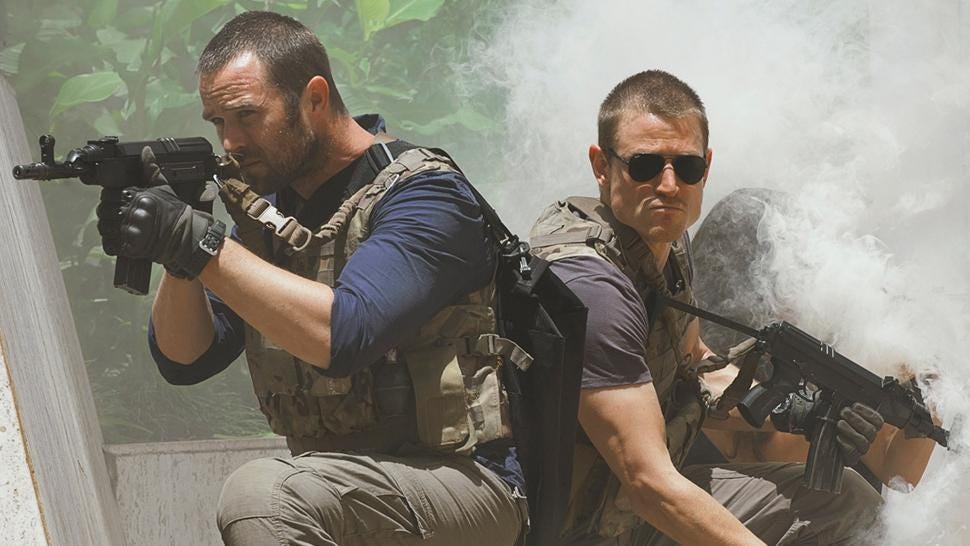
I did notice, rather crucially, that the core theme there, the ethical and moral heroism of the character’s choice, was of no interest. What mattered was the aesthetics of the thing, the image of the (random) strong, handsome man brought low by poison. Which I found terribly disappointing.
This fanlore site talks about the history of whump and explains various aspects of the terminology.
This collection of tumblr posts attempts to define various community-important reasons for whump-attraction.
Here is a link to the “Whumpepedia”, the public spreadsheet that features over 15,000 entries across mediums
Here is a link to a similar, but less comprehensive, list for Asian media with only about 1100 entries.
Here is a tumblr directory of over 500 tumblr blogs dedicated to whump.
Here is one tumblr blog focusing on whump in Asian media. You can scroll through a get a pretty good feel for the whole thing
Here is a tumblr blog devoted exclusively to Supernatural whump
I.c. The Nature of the Community
Here I will provide some links to wacky kerfuffles that have arisen in the world of fan fiction, to give you an idea of the kinds of things that are important, controversial, and worth drama. Some of this is actually a little entertaining.
A fairly comprehensive write-up of the insane situation that emerged when a woman named Tiffany, who was Chinese, ran for a position on the OTW board of directors and mentioned, among other things, that something ought to be done to better regulate the tagging of controversial material (such as explicit stories involving children). Note: she didn’t say she wanted to remove these stories, she just wanted to find a way to address concerns that it was sullying the reputation of fan fiction communities.
Among the highlights: She was accused of being a plant by the Chinese government bent on… stopping AO3 from hosting child porn?
The HIV+ high school AU/cannibal mermaid Hamilton fanfiction incident
(Yes. You read that right.) This one is a wild ride from start to finish, but it does a great job highlighting the insanity that ensues when identity, representation, and emotion become the guiding principles of storytelling.
The Cassandra Clare Plagiarism Debacle
For those who don’t know (I didn’t when I first heard about this several years ago), Cassandra Clare is currently a bestselling writer most famous for her Mortal Instruments series, which is a reworking of her Harry Potter fan fiction.
This write-up is probably more comprehensive than it needs to be — with over thirty citations — but it places the social world of fan fiction in dramatic relief.
In which a fan fiction writer (Harry Potter) created multiple fake identities to both bully and praise herself and also created multiple fake, attention-seeking incidents such as a life-threatening illness, a stalking, etc. and was eventually caught.
The above write-up includes a brief prelude touching on the “Ship Wars” which were intense internet battles between groups that shipped specific Harry Potter characters in specific ways. If you were to look further into this whole thing you’d find stories about spies, attacks, police involvement, etc.
Andy Blake a.k.a “Thanfiction”
This person was responsible for some of the most mentally-ill events in the early eras of current fan fiction. I can’t even begin to do this whole thing justice. There were at least two honest-to-goodness cults. There was even a murder.
I’m still not completely convinced this was real. But, yes, at some point in recent fan fiction history there was a faction of female Harry Potter fans / fan fiction writers who started a cult built around the belief that everything in Harry Potter was real, actually. And that J.K. Rowling had been channeling the (very real) Severus Snape who dictated the books. Severus Snape, by the way, is an immortal deity, and they both worship him and are engaged in romantic relationships with him. (This might still exist.)
The Untamed Xiao Zhan / Wang Yibo China insanity is detailed in the section below on BL (boys love).
II. The Smut-pocalypse
II.a. The Depths of Fan fiction
This subsection is pretty disturbing. I don’t recommend digging into this too much unless you want to ruin your day. The point of this section is to highlight for those who don’t know just how deep and wide and black the pit of fan fiction is. I know there are many people out there who have those favorite “good” fan fiction stories which are not horrifically warped and awful. I’m aware. I still argue that such works in these days are fundamentally restrained by virtue of being fan fiction, but I understand and am aware that some fan fiction isn’t as bad as what I have listed here.
This horrible cursed link that you SHOULD NOT click will take you to the “dead dove do not eat” tag on AO3, if you wanted to see that garbage for yourself. I must warn you, though: you definitely do not want to see that garbage for yourself. Needless to say, it’s all sexual.
The following list will be provided to show you the kind of content that is protected on AO3. I didn’t provide links because it’s horrendous. Take my word for it, you don’t want to see/read it.
There have been various moments in the 17-year history of the site when people have tried to “do something” about the proliferation of disturbing and pedophilic content that seems to collect in all corners of AO3. This has always met with extreme resistance. Coming out and saying openly “this stuff should be removed and banned” is one of the mortal sins of fanfiction, labeled as a kind of oppression, and, obviously, censoring. But even just suggesting that more robust tagging systems ought to be used is enough to get a person removed from consideration for a board position at OTW, as mentioned above. To say that fan fiction communities in general and AO3 in particular protect and facilitate the production and spread of pedophilia material is not an unfair statement.
Age Difference tag — over 138,000 works
Underage Sex tag — over 369,000 works
Father/Son Incest tag — over 10,000 works, the top one of which has over 1.5 million hits and is, naturally, Harry Potter
Pedophilia tag — a tag with over 14,000 titles. One of the sickest things I’ve seen in a while, the top title has over a million hits.
Father/Daughter “Relationship” tag — another soul-killer. Over 23,000 titles, the top one of which, again, has over a million hits.
Sibling Incest tag — over 89,000 titles, the top five of which have over a million hits
Teacher/Student tag — this one has over 31,000 titles. The third most popular one, with over a million hits, features the tag “consensual underage sex”
“Extremely Underage” — over 7,700 works. You really, really do not want to know. My soul, at this point, was completely dead.
Mother-Daughter “Relationship” — over 14,000
Parent / Child Incest — over 32,500
Mother / Son “Relationship” — over 13,000
There are others, of course. Cannibalism kink, necrophilia, bestiality, various tags that include “in front of infant”, etc. But after a while I couldn’t bear to look at any more.
There is also a guide to writing vomitkink (yes, you read that right, no I won’t link it)
*note: I’ve received many messages since making my jab at fan fiction in my video on romantasy and women’s fiction that insist that smut is not the only kind of fan fiction in existence. I addressed this issue in the current video, the fan fiction video, but to be clear: Smut and explicit content — particularly involving taboo themes like incest or even illegal themes like underage sex and straight-up pedophilia — is so important to fan fiction writers that its protection is 90 percent of the reason AO3 was created in the first place. Moreover, it is one of the most widely talked about “censorship” issues in the community.
That being said, when talking about explicit fan fiction in particular, the sex scenes themselves are less the topic. What’s really, immensely disturbing is the depths of depravity which are not only on display, but which are hugely popular and proudly protected.In case you need any more proof that literary awards are no longer worth the paper they’re printed on, in 2019 the entirety of the Archive of Our Own was awarded a Hugo.
The Omegaverse
Something that sits right in between fan fiction and BL is a lovely little thing called the “omegaverse”. A lot of BL stories are set in the omegaverse and many standard fan fiction works — gay or not, it doesn’t seem to matter — also take place in the omegaverse. I have been told that this is distinct from furry-ism (shudder). But, I don’t know... it seems like a next door neighbor, or even a roommate. If you’re curious, here's an explainer that breaks down how it all works, including anatomically.
(This is where you’re getting males who get impregnated and gestate offspring somewhere in the anal canal. I think. Please don’t make me read it again.)
II.c. BL (Boys love)
As I said in my video, there are stories with gay characters, and then there’s BL. These are pretty distinct. Any discourse on this topic here or in my video is referring to BL specifically and its matching fan fiction iteration in which straight male characters are shipped together in erotic stories.
Often, when adapting a BL novel or manga for live action, a lot of the more typical BL elements are toned down to make the story more palatable. This includes, but is not limited to: huge age gaps or instances in which one of the men is drawn in a way to make him appear to be a child; tremendous amounts of sexual violence that is portrayed as erotic, normal, or tantalizing; taboo elements such as teacher / student relationships or varying degrees of incest; often very violent sex, and a lot of it; a frequent theme of the dominant male aggressively and forcibly convincing the submissive male, who is straight, that he might actually be gay, after which they become an affectionate couple. In short, elements that would be universally condemned and possibly even banned were the couples male / female.
A note regarding the links between BL and gay erotic fan fiction
BL and gay shipping (particularly the shipping of male canon straight characters) fanfiction are two matching iterations of fanfiction indulgence unchecked. These particular themes in fanfiction — the BL specific themes and imagery and the more general insistence on shipping any two straight male characters together — indicate an absolute surrender to emotional (and sexual) indulgence. Usually sexual in nature, these particular stories and shipping habits feed a profoundly indulgent, often obsessive, emotional hunger. They also feed each other in an endless loop. This then, as we see in other areas, feeds mainstream literature and storytelling. The more taboo and controversial, the more the community fights for acceptance under various forms. For instance, several posts, articles, and even academic papers can be found online that attempt to legitimize the occurrence of the disturbingly young, girlish boys (many of whom are impregnated — see “omegaverse” above) in BL as being essential for trans representation. Meanwhile, the stats still show that the vast majority of audience members are female.
“Emerging in the 1970s, one root of these works can be found in professional Japanese manga (comics) and the other in anglophone fan fiction. The internet has enabled mass engagement with popular culture across national, geographical, and cultural boundaries and the umbrella genre constituted by yaoi, boys’ love, and danmei may represent the largest erotic subculture by and for women.”
It’s worth adding that many women online are critical of BL fans for insane fanaticism, degeneracy, or just fetishizing the actors and characters. Japan even has a derogatory name for female BL fans that translates literally to “rotten girl” or “rotten woman”. Fans of explicit BL comics and manga are basically the female equivalent of hentai fans. I’ve never personally seen any lolicon “art”, but from what I’ve heard, many BL comics and manga are basically just lolicon for women, as I will demonstrate below.
The impact of BL and gay-shipping on the rest of media
BL and the popularity of gay shipping in fanfiction have led to a cultural environment in which male characters are almost always shipped together. Especially if, in canon stories, they are very close friends or siblings. This includes (but is not limited to): Sam and Dean Winchester in Supernatural, Frodo and Sam in The Lord of the Rings, Gimli and Legolas in The Lord of the Rings, Professor Xavier and Magneto in X-Men, etc. If you wondered about the odd way in which Deadpool and Wolverine were being used to market Deadpool 2, that was an effort to feed the fanfiction beast. Writers and producers are either themselves from the fanfiction community, or they understand that that’s where their most hardcore fanbase is going to be and they know how to feed it.
You see this in productions like Hannibal. When filming the final episode of the final season, Brian Fuller knew what he was doing:“Mads and Hugh, there were a lot of takes where they got very intimate, and lips were hovering over lips. I definitely had the footage to go there, because Mads and Hugh were so game. They called me and warned me: “We really went for it!” And then I saw the dailies, I thought there was a fine line from that #Hannigraham fan fiction motive to give the hardcore audience exactly what they want in terms of this actually being a homosexual relationship between these two men, and what is authentic for the characters in that final moment. I mean, it’s not ‘Brokeback Mountain.’ Mads isn’t gonna be spitting on his hand and getting to work.” (laughs)
This is so prevalent that most straight male characters are now assumed to be canonically gay within fan fiction communities. An example would be the two male leads in the excellent Korean drama Beyond Evil. Or the two male leads in the excellent Chinese drama Under the Skin. (According to fans who had access to the latter show’s official Weibo, they were going to include a female love interest for one or both of these guys in the second season but the fan backlash was so severe that they didn’t. Because, after all, those two men are “canonically” gay in fan fiction fantasyland.)
Here are some links to fan-edited Youtube videos that ship the straight male characters in the above dramas so you can see what I mean:
(x) (x) (x) (x) (x) and (x) (x) (x) (x) (x)On AO3, going solely by the tag system, there are roughly 3 million male/female ship stories, a little over 1 million lesbian ship stories, and over 6 million male/male ship stories. If LGBTQ representation was really that important, shouldn’t those latter two numbers be a little closer together? And given that the majority of fanfiction writers are female, perhaps the female/female number should actually be much higher. Why are the vast majority of fan fiction works written about male gay ships?
This article talks about how the K-pop-esque marketing attitude used to spread BL into the west has proven to be wildly successful (and just beginning).
And of course it has been successful, the road had already been paved by fan fiction. The Venn diagram of gay shipping fan fiction writers/readers and BL fans is almost a perfect circle.
A note on the demographics of BL
The audience and writers are overwhelmingly female. In fact, in the east this genre is specifically marketed to women, not men.
The female readers of BL (also called danmei in China, yaoi in Japan, and Y in Thailand) are between 20-40 years old.
Other sources show that it starts younger
(Personal observation: a huge percentage of tumblr users who post a lot of BL content list their age as “30s”)
The writers of BL are by majority female.
Most of these readers and writers are heterosexual
In the west, a growing percentage of the female readership identifies as “queer”.
Membership in sites and forums that host danmei/BL/yaoi material is higher than you can possibly imagine.
It has been observed that BL is threatened in some western countries for no other reason than that country’s law against explicit material involving children. Which should tell you everything you need to know.
Examples of BL in the Wild:
(You might not love clicking on some of these. If you have a VPN or the ability to use a private browser window so as not to ruin your ad algorithm, you might want to do so.)
The following links would probably be considered NSFW. While not quite explicit in themselves — unless you click on some of the titles — going to those links on, say, a work network might land you in hot water.
Please note: for anything that is pornographically explicit, all that is required is that the reader click a button that says “I am 18 or older”. Though not all pornographic titles are gated in this way.Here is a place where you can read translated BL novels. Go ahead and have a glance at the covers, and then have a look at the genres.
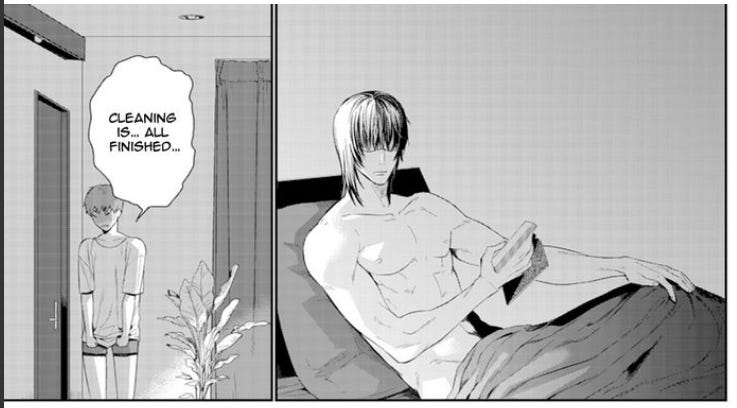
Here is a place where you can see popular translated BL comics (I did warn you). I personally tried to leaf through a few of these but lost the will to live pretty quickly. Some is mostly SFW (if still intensely emotional). But most of it is highly, highly, highly pornographic. (Typically, the less pornographic it is, the more mature the story.) And there is also, very often, the disturbing presence of a younger male character in the pairing who is not canonically underage but who nevertheless has the physique of a young boy. Three comics I tried to read drew the smaller male, when naked, with a boyish body and very little musculature, or as strikingly feminine and young. Another exaggerated the smaller male’s boyish youngness in the explicit scenes; he looked like he was ten, at the oldest. He was literally drawn smaller in those scenes than elsewhere in the manga. I can’t remember the name of this manga, but what I saw of it was among the most disturbing things I’ve ever seen. I couldn’t look at anymore after that.
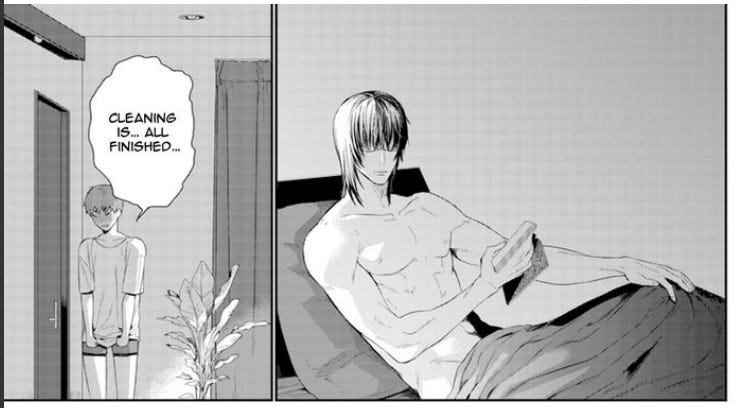
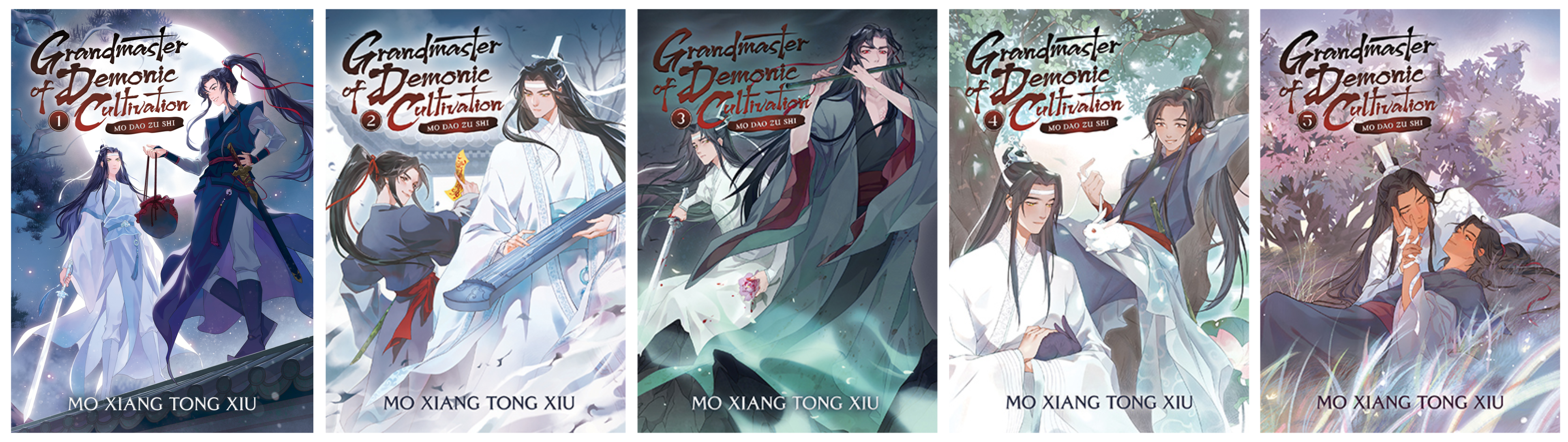
The boy/young man had no sexual experience and his boss had invited him to “sleep over”. The entire story prior to this read like a how-to manual for grooming. All of these stories that I tried to read — particularly those set in modern times — which had two clearly adult men as the main characters also included wildly explicit flashback scenes to when one or both of the men were boys in high school having lots of sex with other boys. This also happens frequently in novels, for example The Grandmaster of Demonic Cultivation, in which the main character traveled back in time to his teenage body and had multi-chapter sex with his teenage boyfriend.
Here is a link to a list of popular tags (← slightly NSFW link). Highlights: mpreg, animal characteristics, and tentacles.
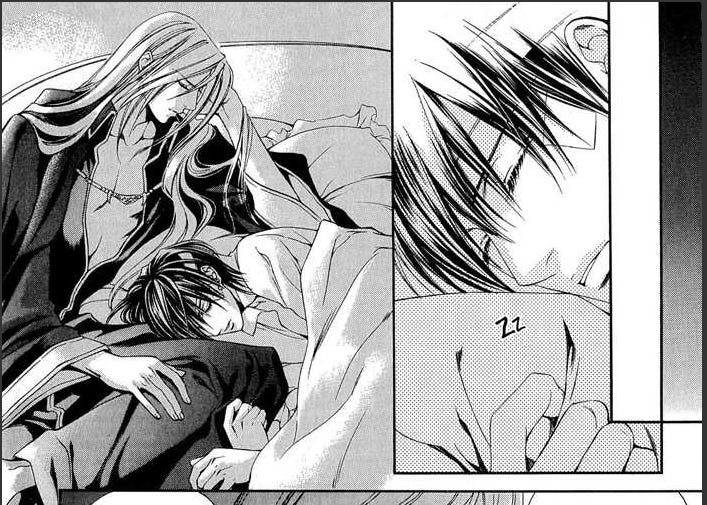
An important component for most BL is that the men are very beautiful, even androgynously so. Even though the stories might include adult men and younger teenage boys (yeah), both had to be unusually beautiful. Including — often especially — the dominant male, who often had luscious, long hair and/or was described by other characters as almost feminine in beauty.
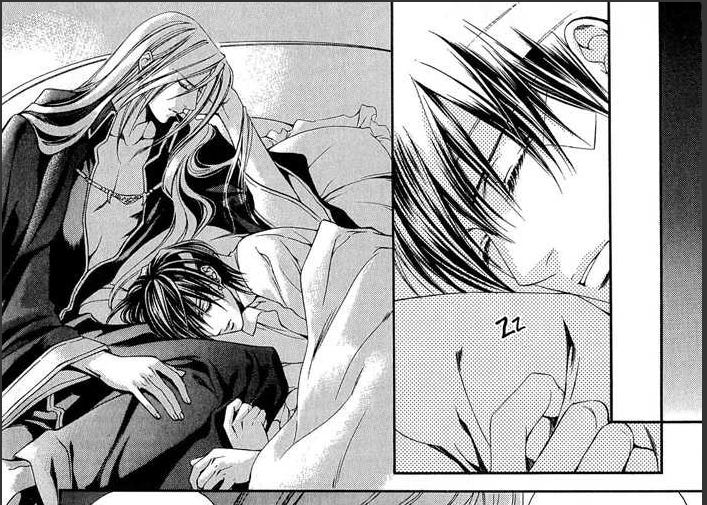
The little guy kept turning into a demon monster and the pretty man would sleep with him. The human didn’t know about this and was traumatized when he found out. Then they fell in love, I guess.
The Nature of BL Fans and Fandom
Here is a link to a breakdown of the insane controversy that exploded after that Chinese BL fan fiction about Wang Yibo and Xiao Zhan broke the Chinese internet. This is a general, detailed timeline of events. It is the least biased accounting I could find on the English-language internet.
(*note: a lot of discourse on this topic tends to focus on perceived homophobia, which was, at most, one percent of what was going on, if that. At the risk of sounding like I’m somehow defending the CCP — I am not — the sexual orientation of China’s citizens is not nearly as big of an issue as the possible cultural influence of Japan. China and Japan have been at each other’s throats for centuries. They are enemies in the biblical sense, with mutual animosity that is unlikely to be resolved any time soon, if ever. Japan was the original breeding ground for BL, so China is resistant to most forms of BL as a genre for that reason above all else.)
(*second note: You still see occasional stories about writers of erotic BL being arrested and getting significant prison time in China. This is often presented as an issue of homophobia. However a closer look always reveals that the offending work includes underage or underage-adjacent characters. Mostly, though, it comes down to money. As it usually does in communist regimes.)
Given the fact that I have yet to come across a single gay erotic novel or manga which didn’t include some underage sex (or underage adjacent) graphically described or drawn, I’d assume that all/most of it has that as an essential component.Here is a link to the original novel (in translation).
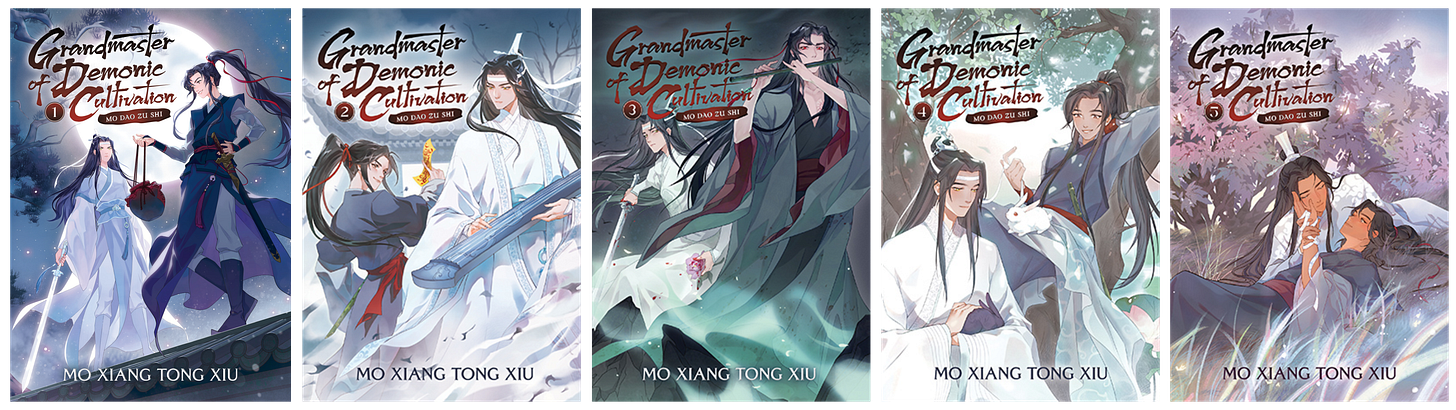
This is the version you can buy at B&N. It’s rated 17+ (several chapters I read were a little startling in their explicitness) “Original” is a bit of a misnomer. Due to restrictions on explicit content, the original original novel, which was published serially online in Chinese, had very little smut, if any. This one was fan translated and distributed across the internet. Many who read that version get very confused if you call The Grandmaster of Demonic Cultivation smutty. But later, the author Mo Xiang Tong Xiu (a pseudonym) released additional chapters on her own blog/website to occur at various parts of the novel which were wildly explicit (a common practice among Chinese BL authors, given that the Chinese Webnovel site has strict restrictions on explicit material, regardless of the orientation of the characters). A lot of the explicit scenes in this novel, and other BL novels, feature a strange theme that attempts to make painful, violent, even forceful sex humorous. This includes, but is not limited to, one of the characters screaming “no!” or “stop!” in a way that is meant to be funny. You also see this in Japanese and Korean BL.
The bottom line is that there are at least three versions of this novel floating around, one of which is fairly tame, one of which is pretty explicit, one of which is extremely explicit.
Here are several links to various aspects of the scandals that erupted around the live action production of the globally popular Thai BL KinnPorsche. I’m using this one as an example because its massive popularity made the scandals that surrounded it very big news in the world of eastern media, a great deal of which was translated into English.
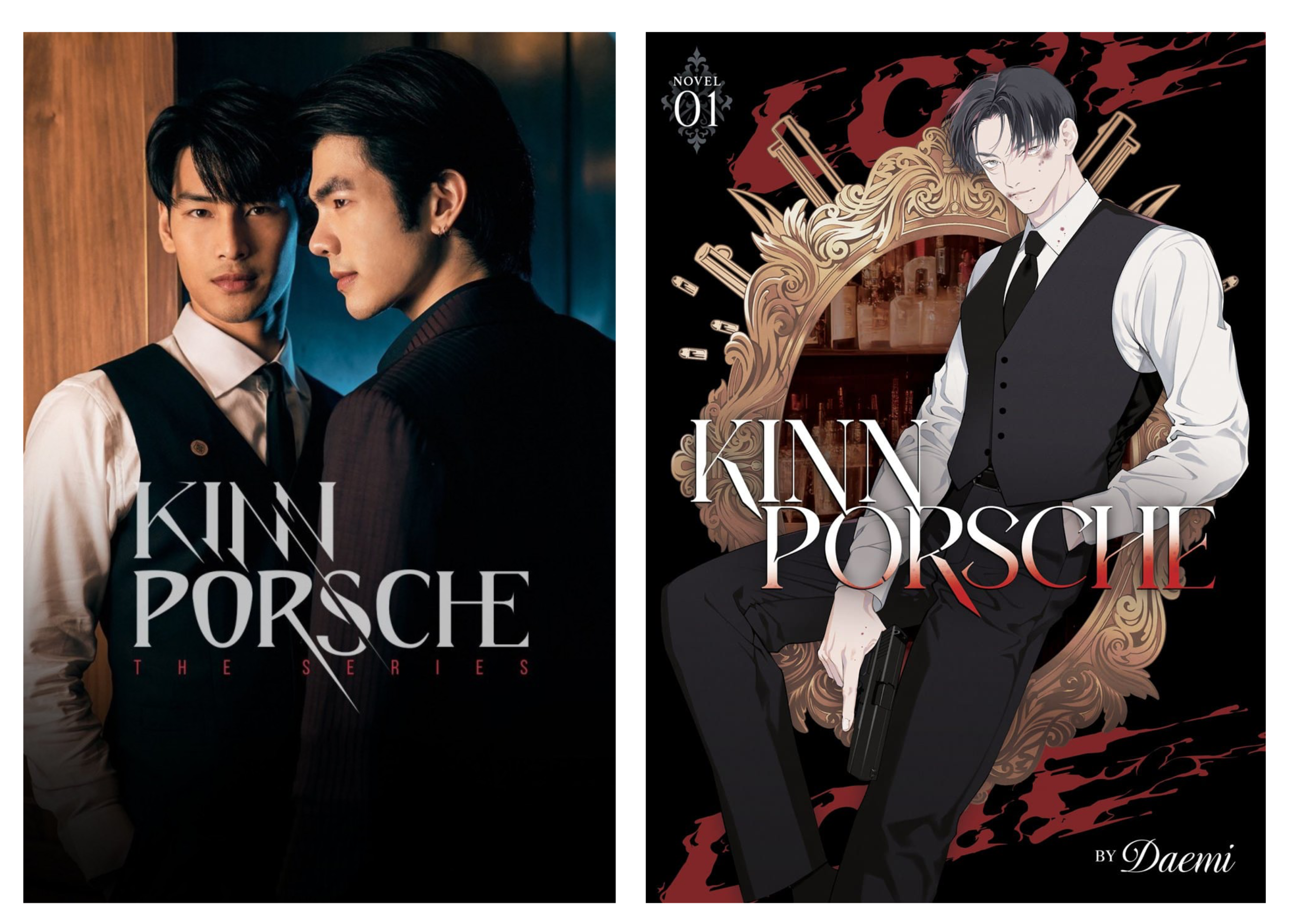
(For anyone curious, this is the series in which one of the male characters, Porsche — the man below on the left — was drugged and nearly sexually assaulted, but then was saved by the man on the right, Kinn… who then took advantage of his drugged, high state to sleep with him himself. This was the beginning of their romantic relationship. The narrative of the drama treated this as both something deeply wrong and traumatizing, while simultaneously being something beautiful. This is common in BL in which even scenes which are treated as canon rape — such as one male lead being kidnapped and raped by a bad guy — are nevertheless described or drawn with erotic, titillating detail. I have been told that this is a seriously toned-down take on the original novel, which I have not read because at this point I’ve reached my limit.)
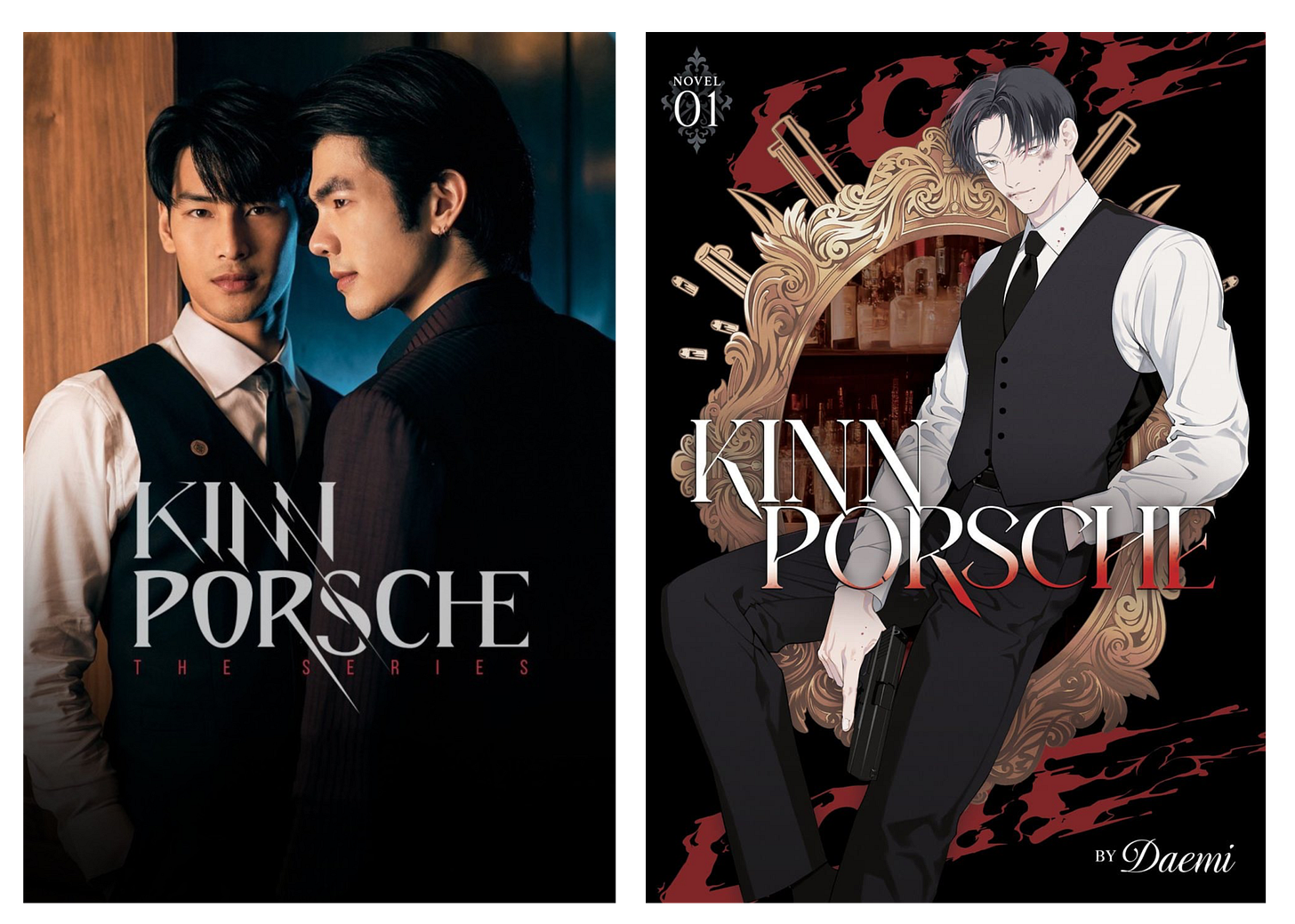
The writers of the original novels (a pair that was a straight female and a gay male collectively known as Daemi) proudly admitted to grooming behavior towards one of the support stars of the show who was 16 years old at the time.
A collection of videos and posts detailing inappropriate behavior by Daemi towards the cast
This comprehensive list of links and sources details a lot of the KinnPorsche novel writers’ deeply disturbing behavior, including harassment, creepy behavior (such as the male writer demanding an actor call him “mommy”), and one of the main male stars explicitly accusing the writers of sexually molesting him. Some of the included videos show behavior that would have been, had the genders been switched, criminal sexual harassment and even assault perpetrated by Daemi — especially the woman — against multiple male actors.
Here are some articles detailing the nature of the fan environment of BLs.
This article includes videos of an incident in which a large group of fans of a star from a Chinese BL called Revenged Love stormed his commercial flight on the runway and physically fought with the flight crew for access to him.
Revenged Love was an enormous hit when it aired and launched the stars into overnight superstardom. There are numerous news stories about stalkers terrorizing the stars. More than usual, probably, because the stars did not, at the time of their meteoric rise, have the experience nor the security to handle what they had stepped into.
This Facebook post by a Thai BL star includes security camera footage of a female stalker who had followed him to his home.
Another Facebook post that translates a Thai post by a BL actor (popular for presenting as a… young teenager) in which he shared multiple messages from a stalker who had gone full Stan and, due to the star’s lack of communication, was now threatening to kill him.
A post in which a talent agency announced it would be taking legal action against stalkers who had invaded a private gathering of the cast of KinnPorsche.
A note: BL, especially BL in Thailand, has its own set of rules that feeds into the obsessive nature of BL fans. For instance, the popular male pairings in dramas are then “paired” in “real life”. They make public appearances together with staged intimacy, casual social appearances together, and even host variety shows together. If one of them is caught dating someone else — especially a woman — he will literally be expected to issue an apology. Stars have received death threats for “breaking up” with the other person in their pairing.
*note: I haven’t watched Netflix’s Heated Rivalry, but the book is insanely explicit. But, like I said, I can’t speak to the relationship dynamics present in the series. However, when I heard it announced I found myself wondering if this would be the gateway series that would allow for western BLs that will be more like the ones I’ve spoken about above…
I heard a rumor that Heated Rivalry started as Steve/Bucky Avengers fanfiction. But I couldn’t confirm that.
It’s worth noting that hockey romance, especially gay hockey smut, got its biggest boost (if not its start) on tumblr and AO3, where many would ship various real-life hockey players and then write wildly explicit smut about them.
(x)
(p.s. There is so much Max Verstappen fan fiction. When will they make the gay Formula 1 Netflix series, I wonder?)(I recently found out that Heated Rivalry is actually a Crave show and not a Netflix show.)
III. Fan Fiction Impacting the World
The tendrils of fan fiction have begun to spread like kudzu throughout all of popular culture, especially anything having to do with storytelling. This, in turn, is already affecting how the human mind is formed and directed.
III.a. Studies on the Ways Fiction Affects the Mind and Behavior
This study talks about wishful identification and how audiences, particularly children and young adults, tend to identify and seek to emulate fictional characters of their gender (typically) whom they admire. Which is to say, if the character is written in such a way that the reader will admire them, they will also, then, begin to emulate them.
“All of the definitions [of identification] involve a bond or connection between an individual and another person (or entity), such that the individual adopts traits, attitudes, or behaviors of the other person, or incorporates the other’s characteristics into his or her sense of self”.
This study talks at length about the way our “real world knowledge” is often cultivated from fictional characters and situations. That is, the fiction we consume informs our perception of reality and how we behave in real world environments.
“The conceptual framework that humans regard as their “real-world knowledge” largely consists of information mediated through stories (e.g., Cinderella, Momotarou the Peach Boy, news items), featuring people they have never met (e.g., politicians) or who do not exist (e.g., faked identities in chat boxes), and broadcasting events they did not witness (e.g., World War II) or that never happened (e.g., a virus hoax).”
A 2024 article in Psychology discusses the observed ways in which fiction viewership impacts not just individuals but societies.
“Researchers studied the impact of telenovelas on fertility in Brazil between 1979 and 1991 and found a significant relationship between a certain media group’s novelas (Globo) and birth rates. It was theorized that the decline in the birth rate in Brazil during this time was partly due to the characters depicted on screen who chose not to have children or delayed having children. The authors believe that the telenovelas played a significant role in a more than 50 percent decline in the birth rate in the country.”
This article speaks specifically about the potentially harmful effects of binge-watching fiction. This addresses an interesting point: that the old style of weekly episodes allowed for a slower intake of the story, which in turn allowed the viewers to consider the details more carefully, as well as discuss them with their friends. Binge-watching places the focus on the punchiest moments in the whole season, particularly the finale.
This might not translate specifically to the fanfiction reading habits, but it does speak to the overall potential of obsessive or addictive fiction intake to harm not just our daily lives, but also our ability to analyze stories and our ability to share them with friends. Storytelling, in the age of binge-watching, has become very solitary. Which, again, allows the individual viewer’s personal engagement and identification with the characters to become ever more important.This fascinating article talks about the cognitive nature of how we experience fictional stories. The impact this has on our opinions, behavior, attitudes, mindset, etc. cannot be overstated.
“Narrative transportation is the sensation of being fully immersed in a story (Green & Brock, 2000). This sense of immersion diminishes our critical thinking through our ‘willing suspension of disbelief,’ reducing the likelihood of counter-arguing or resisting persuasive messages. The more emotionally engaging the story, the more we are transported, the more susceptible we are to the story’s message, and the more it feels true.”
and (the author was using the Netflix show Adolescence as an example):
“When storytelling mirrors a parent’s biggest fears, the metaphors become truth-adjacent—emotionally real, even if not factually so. Psychologist Donald Polkinghorne (1988) defined this as ‘narrative knowing,’ which prioritizes coherence and plausibility over verification. When someone cites Adolescence as evidence, it is a way of expressing emotional and social truth. It does not necessarily reveal any confusion between fact and fiction. However, high production values, natural dialogue, and emotional resonance create perceived realism, making fiction feel ‘more real’ than fact.”
III.b. Fan Fiction Goes Mainstream
Articles discussing the deliberate cultivation of fan fiction works and writers for the mainstream publishing industry
A Sherwood article from 2024 talking about the fan fiction book boom and the cultural acceptance of fan fiction in the literary mainstream
This 2017 article in Forbes details how Twilight fan fiction became 50 Shades of Grey
Fanfiction writer Britta Lundin talks about how much fan fiction has influenced her work as a television writer, specifically for the series Riverdale.
A short list from Audible of some books that were fan fiction works or which were written by authors who got their start in fan fiction.
A post on Twitter in which Chloé Zhao, writer and director of Eternals mentions her fan fiction influence, and even says she intends to write fan fiction about her own film and put it on AO3 under a pen name.
An interview with Damien Gerard, a writer on Our Flag Means Death, on the importance and influence of fanfiction.
“Fanfiction is the lifeblood of the industry. […] So, what importance does fanfiction have? The most importance.”
This article talks about multiple theories regarding the way producers attempt to retake control of their media’s narratives while also appealing to fan groups by meta references to popular “fanons”, using BBC’s Sherlock as an example.
This study examined the ways fanfiction writers had changed how they engage with stories generally. Here’s a quote from one of the interviewed writers:
“One of the weirdest special skills I’ve gotten from reading a bunch of fanfiction is, after watching the movie, knowing exactly what the popular fanfiction on Archive of Our Own will be about for this movie, […] and what the most popular kinds of fanfiction are in a fandom, immediately after watching something or reading something, because I participate in the spaces so much that it influences the way I see media. And that includes the community, because I know what’s popular, because I’ve engaged with other fanfictions, and I write, occasionally, I write what’s popular, because I know what other people want to read, and, yeah, that kind of communal aspect impacts just how I see media and how I engage with fanfiction as well.”
Another article talking about how much more common it is now for fan fiction to be openly referenced by mainstream writers. This one also talks about Ali Hazelwood’s (the author of The Love Hypothesis, a Star Wars fanfiction with “the serial numbers filed off”) success story.
A note: I tried to find the article I read that listed Twilight among the works that were derived from fan fiction stories, but I couldn’t. It’s possible it is just a rumor. It’s possible it’s more than that. But I couldn’t find my source.
Funnily enough, I quadruple-checked everything else in this video, but not that, as that notion has been an accepted fact that I’ve taken for granted for a decade. If anyone knows of a more definite source on this, do please drop me a message, thank you.
III.c. On the Matter Regarding Female Perpetrators of Sexual Crimes Against Minors
There is precious little data on this, as I’m sure most of you are aware. The greatest barriers to data collection and analysis are the tendency of female crimes against boys to go unreported for a variety of reasons, and also the unfortunate dearth of data in general on sexual misconduct done by teachers in public education.
That said, there is some information out there.
This graph showing a comparison between male perpetrators and female perpetrators (both teachers) shows that for statutory rape specifically (not all sexual misconduct, but only statutory rape), female teachers outpace male, but also receive significantly less severe punishments, almost half what men receive. This graph only covers 2013-2016. There are ways to contact the ones who compiled the data for the graph at the source link.
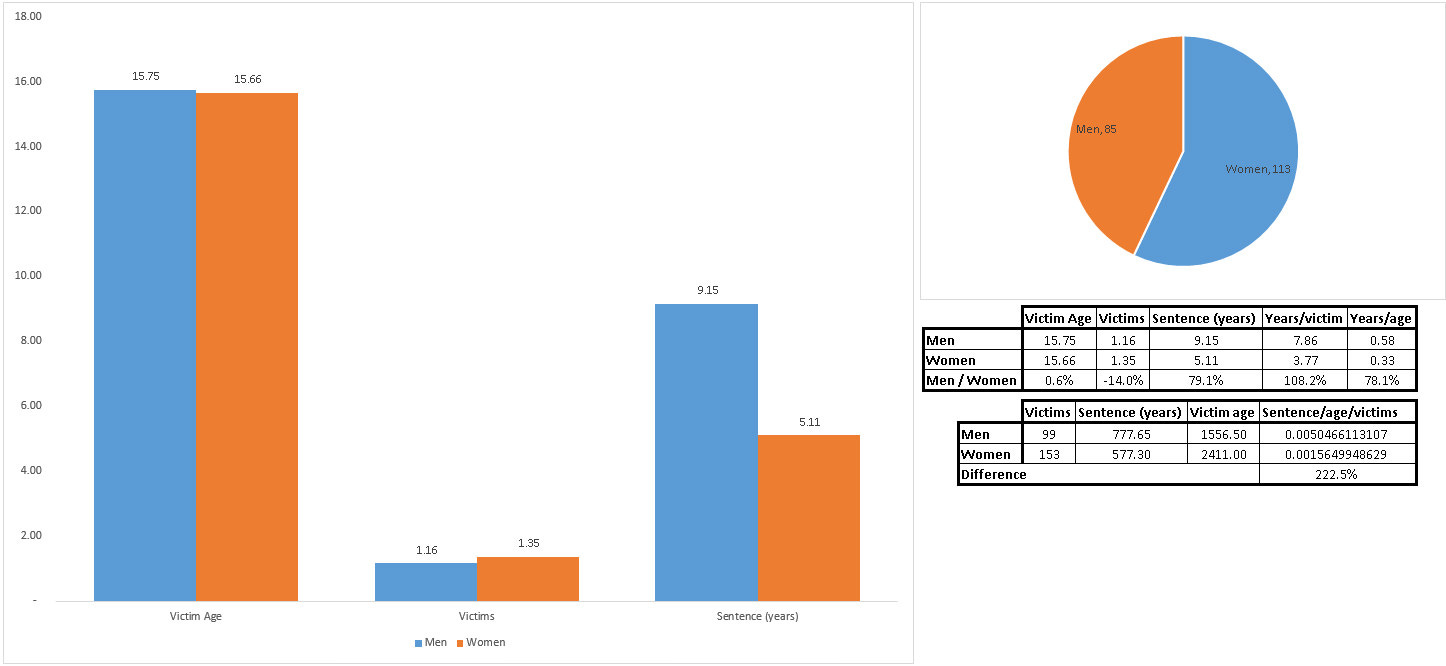
This 2024 study says that female teachers and school staff account for 24.6% of cases of sexual misconduct against minors. Some data suggests that the current year number should be closer to 43%.
This study from 2012-14, which features a section detailing several analyses that were done specifically in Texas, found that in 1994, 4% of offenders were female and in 2003 it was 12%. If we were to split the difference in the above two numbers (24.6 and 43), that gives us a rough current estimate of 33-34%. That represents a constantly rising number which is also growing faster and faster.
However, given the fact that female sexual crimes against males are probably the most under-reported sexual crimes of all, that number could easily be doubled, meaning that the number could actually be higher than 50%.
Conclusion
This is a topic with a hundred interconnected tendrils and is thus difficult to approach directly.
Fan fiction, as I said in the video, is not in itself bad. But our postmodern society, our attitude of absolute permissiveness towards all kinds of degenerate pornography, and a dozen other factors have all combined to produce a creative environment in which the preponderance of fan fiction written is, at the very least, of a tremendously low literary quality. I have no concerns about low-quality fan fiction, they are under no obligation to be masterpieces. But now fan fiction is feeding literature, and this lack of concern towards literary quality has spread into the new literary environment that is entirely choked by fan fiction’s all-important concepts of representation and identity politics.
At worst, however, our current year environment nurtures a spirit in which some of the most mentally, psychologically, and morally damaging material can flourish unchecked. This, too, is of particular concern considering the fact that it has been taking over literature and other forms of storytelling. We are entering an era in which all storytelling is the fruit of fan fiction.
Moreover, a disproportionate amount of fan fiction is not only explicit, but of a profoundly disturbing variety. A number of other concerns appear which are hard to analyze beyond making educated observations. For instance, why are male/male gay pairings so popular among women? Why are there so many stories with teen sex? or characters who appear to be children? when the majority of AO3 users are in their 20s and 30s? Why does AO3 work so hard to protect explicit material involving children when such material is not protected by the First Amendment?
I pose the questions not to start fights, but to start conversations, real conversations. Because fan fiction is ruining not just literature and other storytelling, but also itself. Fan fiction could be wonderful. But it was the first casualty of whatever this thing is that is now infecting the rest of literary culture.
Or, if you’d prefer to make a one-time donation, you can
Apologies for the wikipedia link, but it is very comprehensive and well-sourced. A good jumping-off point for the topic.
There's a rule in the fanfic community - waddling through 90% of the trash is worth it to find the 10% of treasure. And while I do agree with your points for the MOST part, I would push back and say that there is a heavy negative bias bleeding though. I grew up and then grew out of reading fanfiction - but at the same time, I grew up also reading Milton and Dante and Blackmore and Wolfe, lost in the stories of Wilber Smith and the voice of Homer. To this day, I still read specific fanfic authors simply because they knew what they were doing on a character and world and story.
By and large, fanfiction is bad - but calling it the source of all literary decline is a bit of a stretch - and relieves the publication and writing industry of its own faults and weights in the argument.
It's reductive, I mean - in the sense that there are a multitude of points on the timeline where we can point to and call it the start of the decline. Hemingway and his influence, Gordon Lish's influence on the modern editing process, the codification of the Workshop style, and the degradation and misinformation of modern MFA reading techniques. The loss of proper linguistical and etymological knowledge as foundational to writer knowledge, the proper ability to read, the normalization of methodical and slow reading, verbal reading, self critique. I think it's indicative that if people THINK projecting fanfiction ideas and ideals onto other mediums - then there is a broader issue at play. I hate Wattpad, personally, and I found most of the stuff on AO3 to be utter garbage, but I also understand that most of it is self indulgent on purpose.
I think fanfiction is something that is actually healthy - alongside other fringe mediums emerging like Web serials, web novels, Manhwa and Manhua - because unlike publishing, with its own content moderation, and PR concerns, they allow for DIFFERENT story ideas to emerge. Parahumans, Omniscient Reader's Viewpoint, SSS-Class Revival Hunter - these are all excellent pieces in their own right, in both their web novel format and, for the latter twos, comic form. Ciaphas Cain: Warmaster of Chaos, The Weaving Force, Not This Time Fate, From Fake Dreams, I'm Still Here - all excellent pieces of fanfiction writing (these are just the ones that came to mind in the moment).
To reduce it all down to smut and derivative is not exactly an honest assessment of the medium, and to directly quote your post:
"It’s my belief that cancel culture in literature is in large part due to the growing prevalence of fan fiction community rules in the real world."
I find this statement largely ignores the overall media and cultural landscape we exist in. While there is a LARGE fanfiction community, it is largely divorced from the actual political and publishing industry, though I am aware that there is an overlap of editors and publishers now and previously monitoring these sites for engagement to for an easy "this will sell" author that already has a pre-established community - though this is also not exactly indicative of the role of fanfiction being the cause of writing's decline, and I would posit that it is more illuminating on the nature of the publishing industries capitalistic and LCD approach to writing and reading.
In fact, I can't even say that this is an honest based assessment and that the title and conclusion is hitting on two predominately different points. To quote your blog post again:
"*note: I’ve received many messages since making my jab at fan fiction in my video on romantasy and women’s fiction that insist that smut is not the only kind of fan fiction in existence. I addressed this issue in the current video, the fan fiction video, but to be clear: Smut and explicit content — particularly involving taboo themes like incest or even illegal themes like underage sex and straight-up pedophilia — is so important to fan fiction writers that its protection is 90 percent of the reason AO3 was created in the first place. Moreover, it is one of the most widely talked about “censorship” issues in the community."
Firstly, as you note in your blog post - AO3 was largely created due to the purges that occurred on other sites, predominately Fanfiction Net and its like, and a large majority of the writers who wrote there that were banned and works that were removed migrated over to AO3. It's widely known that AO3's entire brand is built on the inclusion of EVERYTHING - for good or ill. My question is that if you predicated your entire engagement with fanfiction based, from what I have listened to and read, on primarily the immoral and sexual content posted there - then you have not really engaged with Fanfiction - you've engaged with the primary source of not just Smut Fanfiction, but the spaces that actively cater towards it. Then you attribute that, alongside side some general and what I assume are personal biases, to strip the nuance of the discussion around the decline of literature and 'literary fiction' to focus on a largely small role player in the grander space.
I will quote your final paragraph on your blog here too:
"I pose the questions not to start fights, but to start conversations, real conversations. Because fan fiction is ruining not just literature and other storytelling, but also itself. Fan fiction could be wonderful. But it was the first casualty of whatever this thing is that is now infecting the rest of literary culture."
I engage with you thusly - how did you arrive at the conclusion you did that "Fanfiction Has Destroyed Writing (And Everything Else)" - and are you engaging with the concept, or the output of a community within it? Are you engaging with a genuine discourse of the impact it has on writing, as a medium, or on the bits that are now bleeding into the cultural zeitgeist? Because while you are correct- there are absolutely steps needed to be taken in the fanfiction community on the nature of the content produced - but there is a world of difference between THAT and the content itself leading to the decline of readers and literacy and literature and writing ability. That, I think, is a much broader and much more nuanced discussion.
Also note: I am not saying this to be contrarian or defendant - I ask this from a place of genuine curiosity, because the delivery and voice and such feels largely different from your other posts and videos. This largely was written in YouTube comments, but I thought it might be better served posted here, direct and out of the quagmire of the YouTube comments. It just feels more... dismissive? Insulting? Rather indignant and personal - the overall tone and voice. Like a Roman walking into a Celtic camp and calling them all barbarians? At least that is how i heard it - because there is not much of the nuance you'd usually bring, and the entire focus seems to be on the SEXUAL content posted, and not on the medium and nature of fanfiction itself. It just feels different from what you usually post, is all
Also: Yes, Twilight and Fifty Shades were originally fanfiction. Twilight is a bit iffier, as it was largely inspired by My Chemical Romance according to Meyer, and might have originally been drafted as fanfiction of that. Fifty Shades was a fanfic of Twilight.
Your recent YouTube video was one of the most insightful things I’ve watched in a long time. I came over here because your work deserves far more reach. Please keep going.